Dr. Ravisha N. S.


Every time a question paper leak makes headlines in India, the response is almost identical. Investigations begin, arrests are made, officials are suspended, examinations are postponed or cancelled, and fresh dates are announced. Unfortunately, after a few months, another examination faces the same crisis. The cycle continues, while lakhs of hardworking students continue to pay the price.
As a management academic and someone who has appeared for and successfully cleared several competitive examinations, I understand what a paper leak truly means to an aspirant. Behind every competitive examination lie months—and often years—of disciplined preparation, financial sacrifice, emotional resilience, and unwavering hope. When a paper leak forces the cancellation of an examination, the greatest loss is not administrative or financial; it is the loss of trust experienced by honest candidates who have earned every mark through hard work.
My intention in writing this article is not to participate in a blame game. Question paper leaks are neither new nor confined to one examination authority, one government, or one state. They have existed for decades across different institutions and administrations. Their repeated occurrence tells us something important: this is not merely the failure of individuals; it is the failure of a system. Over time, an organized ecosystem has emerged around examination malpractice, functioning much like a parallel mafia that repeatedly exploits weaknesses in the existing process. We cannot permanently eliminate such networks simply by making more arrests or imposing stricter punishments if the system itself continues to offer opportunities for exploitation.
As management experts often observe, recurring failures usually indicate flawed processes rather than isolated human failures. Therefore, instead of repeatedly asking “Who leaked the paper?”, perhaps the more important question is, “Why does our examination architecture continue to make paper leaks possible?”
From a management perspective, question paper leakage is fundamentally an Examination Supply Chain Management problem.
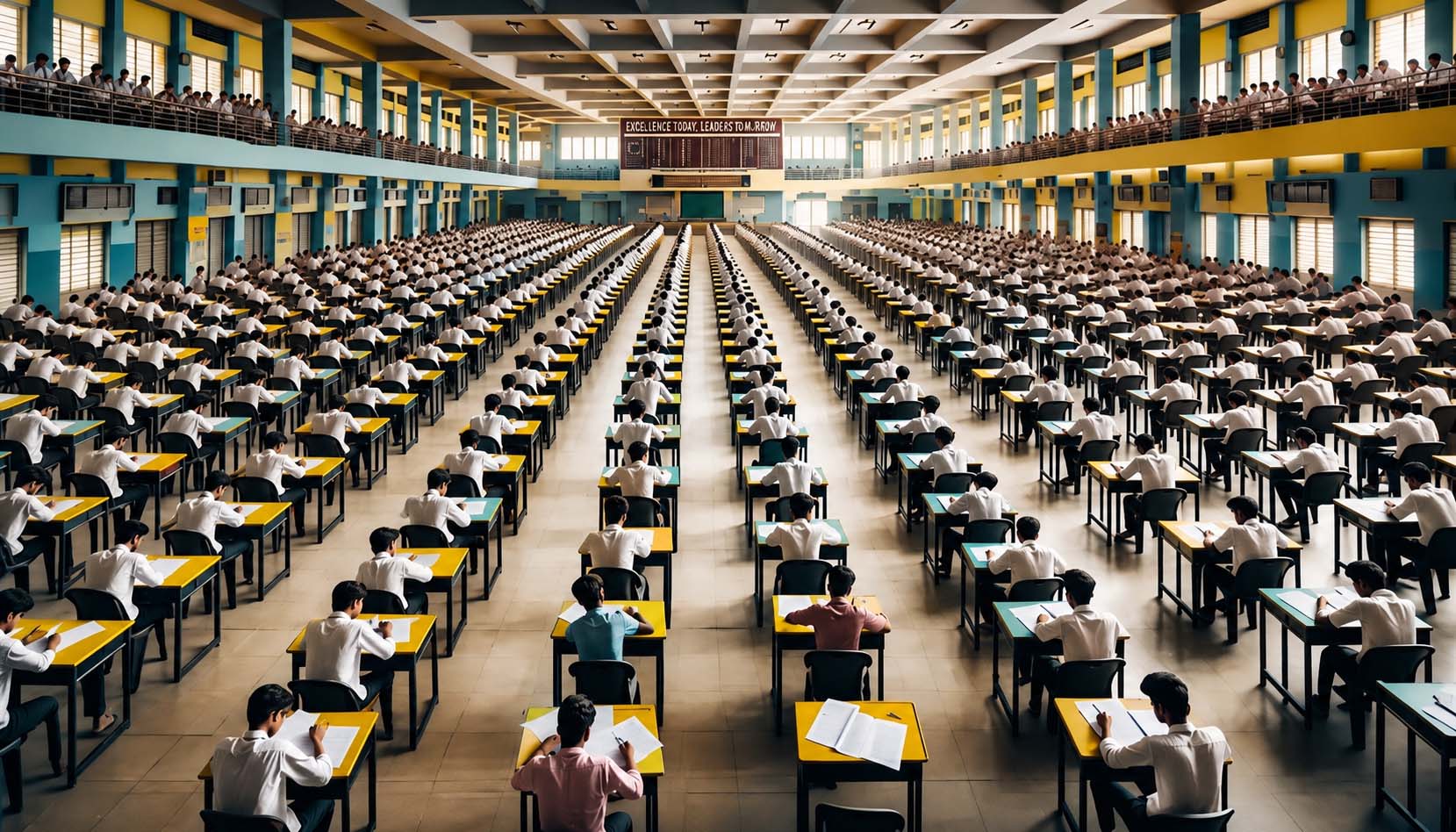
The present examination system follows a long physical supply chain. A question paper is prepared months in advance, reviewed by committees, formatted, printed at secure presses, packed, transported to state headquarters, redistributed to districts, stored in strong rooms, delivered to examination centres, and finally opened shortly before the examination begins. Every stage introduces additional people, physical handling, storage, transportation, and administrative intervention. Every transfer point becomes another potential vulnerability.
No supply chain, however secure, can completely eliminate risk when a highly confidential product physically moves through numerous locations over an extended period. The longer the question paper exists before the examination, the greater the probability of accidental disclosure, insider compromise, organized criminal activity, or cyber-assisted manipulation.
Therefore, I believe the time has come to stop strengthening an outdated system and instead redesign it completely.
The permanent solution lies in transforming India’s Physical Examination Supply Chain into a Digital Examination Supply Chain.
Instead of preparing and protecting a single confidential question paper months before an examination, the country should adopt a Just-in-Time Digital Examination System, where the final question paper is generated only ten minutes before the examination begins.
This proposal begins several months before the examination itself. The Board of Examiners (BoE), university professors, experienced teachers, psychometricians, assessment specialists, and subject experts should collaboratively develop a comprehensive National Digital Question Bank containing tens of thousands of carefully validated questions. Every question should be scientifically classified according to syllabus unit, learning outcome, Bloom’s Taxonomy, difficulty level, cognitive complexity, estimated solving time, and previous usage history. At this stage, no final examination paper exists. Only an academically validated repository of questions is created.
Once the question bank is ready, the examination authority should prepare a detailed blueprint specifying syllabus coverage, chapter-wise weightage, distribution of easy, moderate, and difficult questions, question types, and overall assessment objectives. The blueprint defines academic quality and fairness, while the actual questions remain unknown until the last few minutes before the examination.
Approximately ten minutes before the examination, a secure AI-assisted algorithm should automatically generate the final question paper according to the approved blueprint. The system would ensure complete syllabus coverage, balanced difficulty levels, appropriate cognitive distribution, elimination of duplicate questions, and adherence to psychometric standards. Most importantly, until that exact moment, no individual—including paper setters, senior administrators, examination officials, or technology personnel—would know the contents of the final paper. Since the paper does not exist beforehand, it simply cannot be leaked.
Immediately after generation, the paper should be encrypted using modern cryptographic standards and transmitted through a secure national digital network. India, however, is geographically diverse, and any practical proposal must acknowledge operational realities. Many examination centres are located in rural and remote areas where internet connectivity and electricity are not always reliable.
This challenge can be addressed without compromising security. Encrypted examination files may be transmitted to examination centres several hours before the examination. However, the digital decryption key should be released only ten minutes before the scheduled start time. Without the key, the encrypted file remains unreadable regardless of who gains access to it. Every centre should also maintain UPS systems, backup power supplies, secondary printers, multiple communication channels such as broadband and 5G, and emergency contingency protocols. Remote centres may additionally utilize satellite communication or controlled offline recovery mechanisms wherever necessary.
Cybersecurity must become an integral part of this architecture. The system should operate through geographically distributed data centres protected by Hardware Security Modules (HSM), multi-factor authentication, zero-trust security architecture, continuous penetration testing, independent cybersecurity audits, immutable audit logs, and strict role-based access controls. No individual should ever possess complete authority over the entire examination process.
A common criticism is that the question bank itself could be leaked. While theoretically possible, such a leak would have very limited practical value. If the repository contains one hundred thousand scientifically prepared questions and only a few hundred are randomly selected moments before the examination, predicting the exact combination becomes computationally and operationally unrealistic. The security objective therefore shifts from protecting individual questions to protecting the dynamic question-generation process itself.
Naturally, implementing such a national system requires investment. Digital infrastructure, cybersecurity, software development, staff training, and legal reforms involve significant expenditure. However, the financial cost of repeatedly cancelling examinations, conducting re-examinations, managing litigation, investigating leaks, and compensating administrative failures is already enormous. More importantly, no financial calculation can adequately measure the emotional burden imposed upon millions of sincere students whose dreams are delayed because of systemic failures.
India has already demonstrated remarkable capability in large-scale digital transformation. UPI revolutionized financial transactions. Aadhaar transformed digital identity. Digital governance has improved public service delivery across sectors. The examination ecosystem deserves the same vision and technological leadership.
Education remains the backbone of a nation’s prosperity. It shapes future civil servants, scientists, teachers, doctors, engineers, entrepreneurs, judges, researchers, innovators, and political leaders. When the credibility of examinations is compromised, the credibility of merit itself begins to weaken. Protecting the integrity of examinations is therefore not merely an administrative responsibility—it is an investment in national development, social justice, and public confidence.
The future of examinations should not depend on stronger locks, thicker envelopes, additional police deployment, or ever-increasing surveillance. It should depend upon better system architecture.
The real solution is not to hide question papers more securely.
The real solution is to ensure that the final question paper does not exist until the last few minutes before the examination begins.
Question paper leakage is not simply a criminal incident; it is evidence of an outdated examination architecture. By redesigning India’s examination supply chain from a vulnerable physical logistics model into a secure, intelligent, AI-enabled digital ecosystem, we have an opportunity to permanently eliminate one of the oldest threats to educational integrity. This is not merely a technological reform—it is a national educational reform whose time has come.
Dr. Ravisha N. S.
23-7-2026